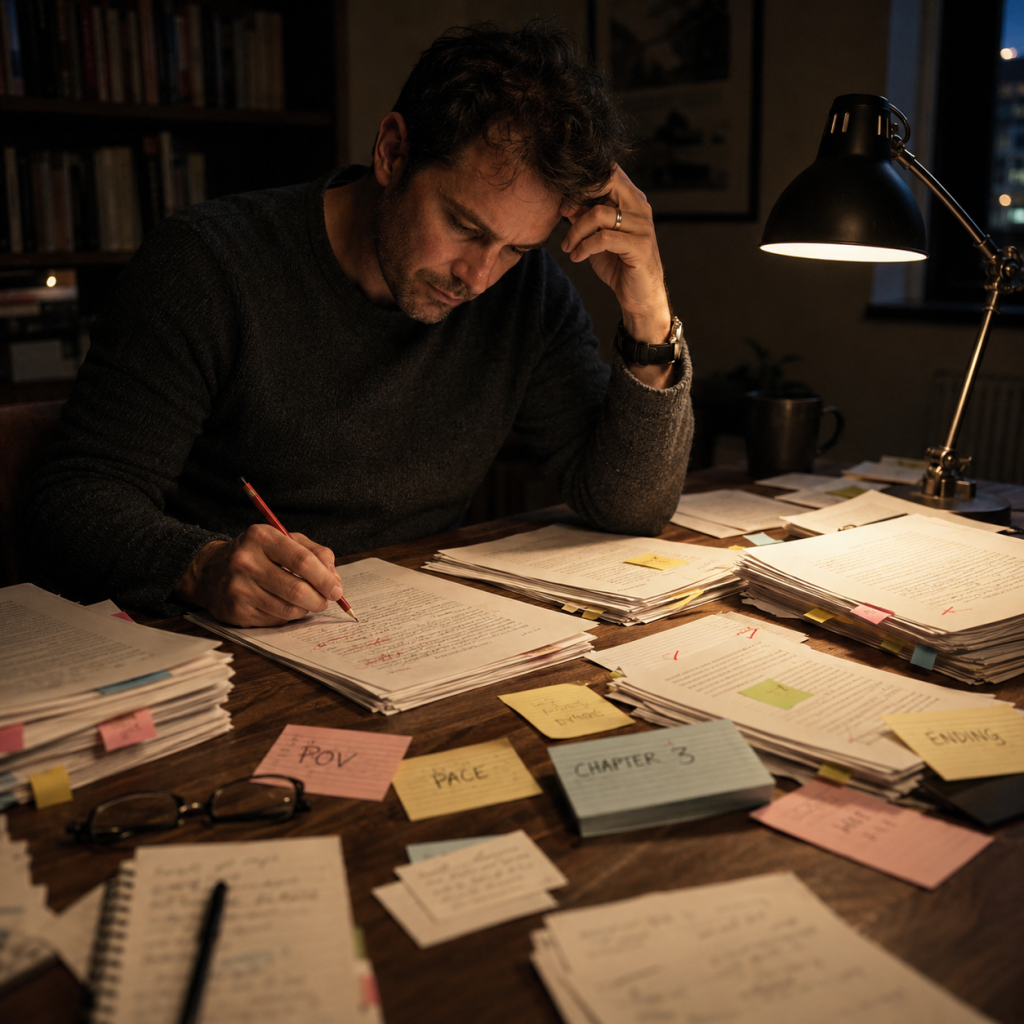
The hour after feedback lands is the worst possible time to act on it. The editorial letter feels enormous, every line of it true and damning. The beta notes feel personal even when they are scrupulously kind. A single comment about one confusing scene starts to swell until it sounds like a verdict on the whole book and, somewhere underneath that, on you. Writers in this state do one of two things, and both are mistakes. Some throw the manuscript in a drawer and decide they were never any good. Others open the file immediately and begin slashing, trying to fix everything at once, in the same panicked mood, and end up doing real damage to a book that mostly worked.
There is a better step between receiving feedback and revising from it, and it is not a glamorous one. It is sorting. Before you change a word, you give every piece of feedback a job, so that you are not trying to solve forty problems of wildly different sizes simultaneously, on the same afternoon, while your nervous system is still treating the whole thing as an attack. I think of it as triage, and like medical triage, the point is not to pretend nothing is wrong. The point is to decide what to treat first, what can wait, and what is not actually a wound.
Sort Before You Solve
Read through all the feedback once without touching the manuscript, and put each note into one of four buckets.
Fix is for a note that names a real problem and points to a clear repair. A timeline that contradicts itself. A motivation that was never established before the choice it is supposed to explain. A scene that depends on information the reader doesn’t have yet because it arrives two chapters later. These are the satisfying ones. You can see the problem, you agree it is a problem, and the path to solving it is obvious. Do these with confidence.
Test is the most important bucket and the one writers tend to skip. It is for notes that locate a genuine discomfort but propose the wrong cure. A reader says, cut the chapter where she visits her father. Your instinct is to defend the chapter, because you know it matters. You may both be right. The chapter may be essential, and it may also be starting in the wrong place, or running twice as long as its single important beat requires. The reader felt something real; their proposed surgery is just aimed at the wrong organ. Notes in this bucket need investigation before action.
Watch is for the single response that might mean something if it returns. One reader misses a clue. One reader finds a character cold. One reader thinks the middle sags. A single data point is not a pattern, and revising to satisfy one reader’s private reaction is how books get sanded into something that offends no one and moves no one. So you mark it, you keep it in your peripheral vision, and if a second or third reader independently lands in the same spot, it graduates to a different bucket.
Ignore is for the note that would turn your book into a different book. Not a worse note, necessarily, and not an ill-intentioned one. Simply a note that pulls toward a novel you are not writing, a warmer ending, a tidier moral, a more conventional shape. The relevant question is never whether the reader meant well. It is whether the change serves the book you are actually making. Some notes, you let go without guilt and without argument.
It helps to watch a single note travel through the buckets, because the same words can belong in any of them depending on what you find when you look. Say three readers and your editor all comment on the same chapter near the end of the second act. The editor writes, “this scene feels like a detour.” One beta reader writes, “I got bored here.” Another writes, “I wasn’t sure why this was in the book.” Taken as instructions, these are useless and mildly crushing. Sorted as evidence, they start to move. The fact that four readers stalled in the same place is not a Watch; the repetition has already earned it more than that. So you go to the chapter and ask what it does. If it turns out the scene resolves its tension on the second page and then runs for nine more, that is a Fix: cut to the turn. If the scene is doing essential work but starting in the wrong place, that is a Test: the readers are right that something’s wrong and wrong about cutting it. And if the scene is the only place a quiet motif gets established, you might land on Watch or even Ignore, choosing to make its purpose land harder rather than removing it. One cluster of notes, four possible jobs, and only reading the actual page decides which.
Always Ask Where It Happened
Underneath good triage is a habit worth building on its own: insisting that feedback have a location. “The middle felt slow” is a feeling, and you cannot revise a feeling. “I started skimming after the conversation with the sister and didn’t lock back in until the hotel scene” is a map. Now you have somewhere to stand. You can go to that stretch and interrogate it. Did a scene there resolve its tension too early and leave the following pages with nothing to push against? Did a chapter begin after its real moment had already passed? Did the protagonist’s wanting go quiet for a dozen pages? Did the prose start explaining what the scene should have been showing?
This matters most with the broadest, most disarming notes. “I didn’t connect with her” could mean four entirely different things. She might be withholding so much that the reader has nothing to hold. The scenes might be reporting her pain instead of dramatizing how she behaves under it. Her motivation might arrive too late to make her early choices legible. Or that particular reader might simply have wanted a more comforting protagonist than the book intends to provide. Four diagnoses, four different revisions, and only the location can tell you which one you’re facing. A note without a “where” is not useless, but it is not yet usable, and part of triage is being honest about which is which.
Then Work From Large to Small
Once everything is sorted, revise in order of size, and resist every temptation to do otherwise. Structure first: causality, stakes, chronology, point of view, the places where the reader stops trusting the book. Then scenes. Then paragraphs. Then sentences. Then, last of all, the line-level and copy concerns.
This order is not fussiness; it is the only sequence that doesn’t waste your work. There is no point polishing a paragraph inside a chapter you might cut. There is no reward for perfecting the rhythm of a scene before you’ve decided whether the scene still belongs. Writers who edit small-to-large end up lavishing care on material that disappears in the next structural pass, and the labor lost that way is demoralizing in a specific, avoidable way.
None of this makes feedback comfortable. Good feedback is often supposed to be uncomfortable, because it is asking the book to be more honest about what isn’t working yet, and honesty has a cost. But triage changes what you are holding. Instead of a heap of opinions pressing on you all at once, you have a sequence of decisions, sized and ordered, each one waiting its turn. The book stops feeling like a referendum on your talent and starts feeling like a project again. That shift, from dread to a list, is most of the battle.
Triage doesn’t make the feedback smaller. It makes the next right step easy to see, and the next right step is all you ever actually have to take.
e.
Cross-links
- What Beta Notes Reveal – on reading feedback for patterns
- When an Edit Becomes a Rewrite – on knowing when a fix is larger than a sentence
- What a Line Edit Fixes – on the later sentence-level pass