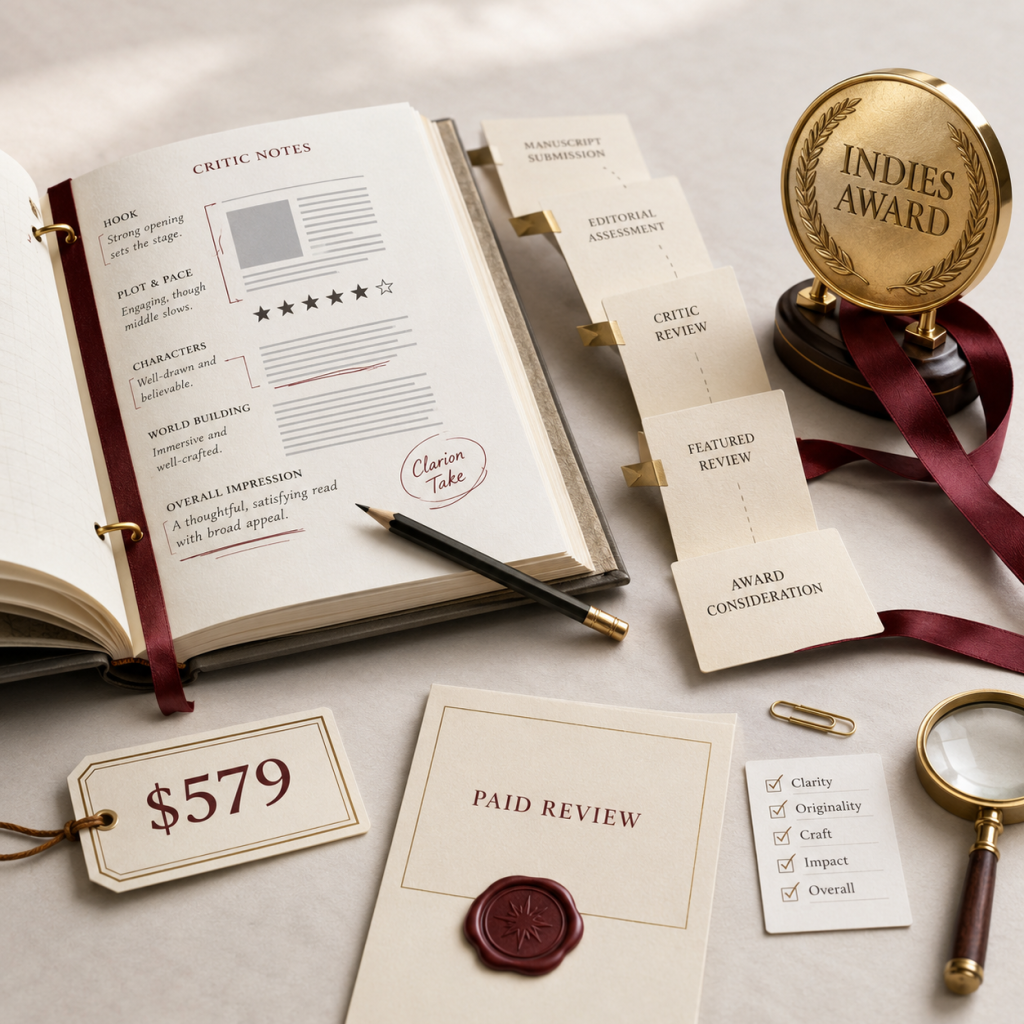
Foreword Clarion is easy to misread as a single product — a review you pay for. It is actually three separate things under one brand: a paid review with a star rating, a syndication pipeline that runs to library wholesalers, and a separate paid award program with its own fees and deadlines.
The $579 review fee covers only the first of those. The award costs extra, and its eligibility rules are stricter than authors often assume.
The submission mechanics — where Clarion slots in a backward-from-pub-date calendar, the sell-sheet anatomy every outlet wants, the IBPA discount math — already live in the Kirkus, Publishers Weekly, and Foreword submission playbook, so I won’t repeat them here. What follows is the economics of the paid review itself: what the fee buys, what the star scale means, how long it takes, what the contract does on day 14, and how the INDIES award attaches.
A note on the figures below. Several numbers that matter most here are inconsistent on Foreword’s own pages — turnaround and review length especially differ from one official page to the next. Where that’s true, I flag it rather than present one number as settled. The fix is the same in every case: confirm the live term in writing before you pay.
What the fee actually is
The paid review is $579 per book. That is the public Clarion price, flat; no rush tier is listed on the order pages. With no express upgrade available to skip the queue, the turnaround question (below) matters more than it does at services that sell a fast lane.
Note what that $579 is not. It is not the free Foreword Reviews magazine consideration — that’s a separate, no-fee editorial lane for forthcoming titles, with copies wanted at least four and a half months ahead of publication and only about 100 books reviewed per issue. And it is not the INDIES award entry, which has its own fee schedule. The free magazine lane, the paid Clarion review, and the paid INDIES award are three different things, and they are easy to confuse.
Clarion also appears as the partner review in a bundled two-review package with BlueInk Review, listed at $799. Against the separate sticker prices of $445 for a BlueInk standard review plus $579 for Clarion, the bundle saves money if you were going to buy both anyway.
The star scale, and the parts of the review you can actually use
Clarion delivers an objective review with a star rating, a “Money Quote” pulled for marketing reuse, and an opening paragraph written to be repurposed in your own copy.
Two of those three deliverables are built to be lifted. The “Money Quote” and the marketing-ready opening paragraph exist so you have quotable prose, not just the fact that a review happened — a point in Clarion’s favor.
The review length is where Foreword’s own pages stop agreeing. Different official Clarion pages describe the deliverable as an objective 450-word review, as a 400+ word review, and as a 400–600 word review. Call it roughly 400 to 600 words, which is still the longest paid review in this part of the market. But if length is central to your decision, confirm the current number against the live order page before you pay (⚠️ VERIFY against live site).
The star scale is not a pass/fail gate. A mixed Clarion review is still a review, and a 3-star write-up with a strong Money Quote can be more useful on a cover than a 4-star one with no quotable line. The star is the headline; the Money Quote and opening paragraph are what you’ll actually print.
Turnaround: the number that contradicts itself
This is the figure to be most careful with, because Foreword’s pages disagree, and the gap is large.
Some current Clarion service and terms pages state a turnaround of 4–6 weeks. A separate Clarion page describes the service as conceived to return a review within 90 days. For planning purposes those are different promises, and both appear on official Foreword pages (⚠️ VERIFY against live site).
This matters more for Clarion than for most services because there is no rush tier. At an outlet that sells express delivery, you can pay to reduce the uncertainty; at Clarion you take the queue you’re given. So if you are submitting against a hard date — a cover lock, a pre-order campaign, an award entry that wants the review quote in hand — don’t assume the optimistic end of the range. Plan against the longer figure, or get the current turnaround confirmed in writing before you order.
The 14-day clock, and what publication actually commits you to
The order is non-cancellable once placed. Foreword states it is under no obligation to provide a review at all — but if it declines a book, it refunds the payment and returns the submitted copies. So you can’t change your mind, but Foreword can decline and make you whole if it does.
The clause that catches people is the posting window. After Foreword delivers your review, it is posted publicly after 14 days unless you opt out in writing before that window closes. This is the opposite of how Kirkus Indie works: Kirkus lets you keep a disappointing review private indefinitely by never authorizing publication, while at Clarion silence means publication. If a mixed review lands and you do nothing, it goes live.
The reach is also hard to reverse. With your permission, Clarion posts the review to Foreword’s site and licenses it to wholesalers. Official pages name Ingram, Cengage, and Bowker “among others”; another Clarion page also names Baker & Taylor. After the review has been sent to those third parties, you can ask Foreword to remove it from Foreword’s own site, but removal from the downstream third-party databases is not available under the terms. So the 14-day clock buys durable library-channel visibility and limited ability to take the review back.
The working practice: read the review the day it lands, decide inside the first few days rather than on day 13, and know before you order whether you would ever publish a mixed result — because the contract makes “do nothing” a decision to publish.
The AI clause that can void the whole thing
One eligibility rule sits upstream of the economics above and can override them. Foreword’s review and award pages both state that Foreword does not accept submissions containing AI-generated content or illustrations, and that if such content is discovered after receipt, there will be no refund and no return of physical materials.
For a paid, non-cancellable order, that is not a footnote. If any AI-generated text or artwork touched the manuscript, the cover, or the interior, get a written ruling from Foreword before you order — not after, when the no-refund/no-return language is already in force.
The INDIES award: the third door, and why people miss it
Beyond the review itself, the award Clarion connects to is the Foreword INDIES Book of the Year Awards. This is a separate, paid program — not something the $579 review fee covers — and it is unusually concrete about its terms.
The INDIES fee schedule is published and tiered by deadline. Per the current schedule: $99 for the first category and $79 for each additional category through June 30, 2026; $109 / $89 through September 30, 2026; and $119 / $99 after that (⚠️ VERIFY against live site — fee tiers are date-sensitive and the early-bird window closes imminently). Pricing is per category, so the headline $99 is a floor, not the total, if you enter several categories.
What the entry buys is itemized more clearly than at most award programs. Foreword publishes the judging criteria, the submission timeline, and the specific benefits finalists and winners receive: Foreword Reviews coverage, newsletter coverage, website visibility, press-release distribution, a marketing toolkit, 500 foil seals for certain winners, and two $1,500 Editor’s Choice prizes. INDIES is decided by a panel drawn from the trade — librarians and booksellers, by Foreword’s account (⚠️ VERIFY against live site) — which is the exact audience a small press most wants to reach.
Two eligibility constraints decide whether the award is available to you at all. INDIES requires books published in 2026 (the current cycle’s year), and it excludes the Big Five houses and their imprints. For a genuinely independent 2026 title, both are usually fine. But confirm your edition and imprint meet the rules before you budget the entry fee, because an ineligible book pays the fee and learns the bad news afterward.
Where Clarion sits, honestly
Set against the rest of the paid-review field, Clarion’s profile is specific. Among the official offerings I’ve examined, it delivers the longest paid review — roughly 400–600 words against the 250–300 typical of Kirkus Indie or BlueInk — paired with the broadest wholesaler syndication and the most fully developed, separately priced award program. For a literary novel, that combination is the case for buying it: long quotable prose, library-channel reach, and a credible award pipeline judged by trade readers.
The counterweights are equally specific, and they are all things you manage rather than avoid. The official pages contradict themselves on turnaround and review length, so the numbers need confirming in writing. There is no rush tier, so you take the queue. The 14-day clock makes publication the default, and downstream removal is limited once syndication happens. The AI policy is a hard gate with a no-refund penalty. And the award that makes Clarion most attractive is a second fee with its own deadlines and eligibility rules.
None of that argues against Clarion for the right book; it argues against buying it casually. The $579 is not the whole decision — the turnaround you can count on, the publication default you’re accepting, and the separate award math are the rest of it.
The broader question of how Clarion fits among the elite prizes and the full paid-review landscape is covered in Tier One Awards Decoded. This piece is the close read of one vendor; that one compares the field.
Clarion posts your review publicly fourteen days after delivery unless you opt out in writing first. Doing nothing is the same as authorizing publication. Read the review the day it lands and decide before the window closes.
e.
Cross-links
- For where Clarion slots in a full submission calendar, the sell-sheet anatomy, and the IBPA discount math: How to Submit to Kirkus, Publishers Weekly, and Foreword — a Playbook.
- For how Clarion and INDIES fit among the tier-one prizes and the wider paid-review field: Tier One Awards Decoded.