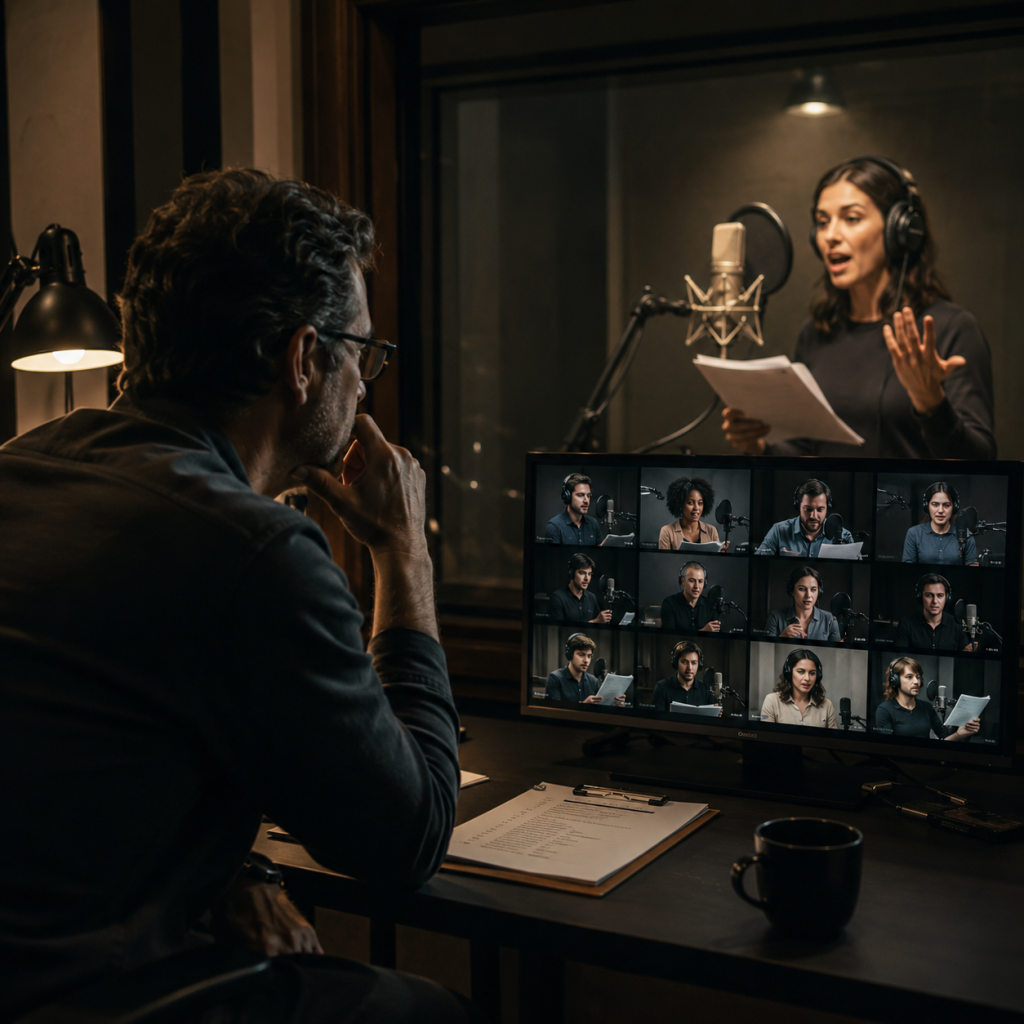
A poorly cast narrator does not simply read a book less pleasantly than a well-cast one would. The wrong narrator quietly rewrites the book. A line you built to be restrained becomes melodrama in the wrong mouth. A silence you placed for tension reads as dead air. Dry humor turns syrupy. A wounded character starts to sound self-pitying. A relationship you rendered with deliberate subtlety becomes obvious, underlined, spelled out by an interpretation that distrusts the listener. For the substantial portion of your readers who will only ever meet the book in audio, that interpretation is the book, and it is not yours anymore. This is why casting is not a clerical step near the end of production. It is one of the most consequential editorial decisions audio involves.
From a publisher’s desk, casting is emphatically not about finding the prettiest voice. A beautiful instrument is welcome, and entirely insufficient on its own. The real question is whether the performer understands the book’s register, its pacing, its emotional restraint, and its point of view well enough to protect them across ten or fifteen hours of recording. Plenty of gorgeous voices have flattened good books, and plenty of less obviously beautiful voices have made them sing, because comprehension, not timbre, is what carries a long performance.
Define the Listening Promise Before You Hear Anyone
Do the thinking before the auditions, not during them, because once you are listening to candidates it is easy to be seduced by competence and lose track of fit. Write down, plainly, what the audio edition has to protect. Is this book intimate? Fast-moving? Wry? Restrained? Unsettling? Warm? Fragmented? Voice-driven? Built around withheld knowledge the narration must not accidentally give away? That short list of qualities is your casting brief, and the narrator’s job is to carry every item on it without overexplaining any of it.
For fiction specifically, listen hardest to three things: interiority, dialogue, and transitions. Can the performer move from narration into a character’s speech and back without turning the cast into caricatures? Can they hold tension quietly, trusting a pause instead of pumping it? Can they let a line land without decorating it, resisting the urge to perform the meaning the listener should be allowed to feel? For nonfiction the criteria shift toward authority, clarity, warmth, and stamina; the narrator should sound like a trustworthy guide thinking alongside you, not like someone announcing copy from a booth. And in both cases, listen for how the voice handles the unglamorous connective tissue, the dialogue tags, the chapter transitions, the ordinary descriptive passages, because that is where most of a long book actually lives and where a narrator who can only perform the big moments will eventually tire the ear. Either way, you are listening for understanding dressed as ease.
Audition the Hard Pages, Not the Easy Ones
The single most common casting mistake is auditioning the wrong material. A writer sends a candidate a pleasant, straightforward passage, the narrator reads it pleasantly, and everyone is reassured by a test that proved almost nothing. The easy page tells you only whether the narrator sounds nice. The hard page tells you whether they understand the book, and the hard pages are the ones to send.
Choose audition material that exposes the book’s actual demands: a quiet emotional scene that could tip into sentiment, a scene with several speakers who must stay distinct, a passage of pure interior thought, a moment of tension with no overt action to lean on, a tonal shift that has to be navigated cleanly, a paragraph where rhythm is doing real work. Then listen, above all, for overperformance, because it is the most common failure mode in auditions. Weak narrators try to make every feeling bigger, mistaking volume for depth. But not every line wants size. Some books need restraint, some need menace held under perfect politeness, some need humor that never once points at itself. A narrator who makes everything large will make your careful book loud, and loud is not the same as good.
Casting Is Also Setting the Narrator Up to Succeed
It is worth saying that casting does not end when you choose a voice, because even the right narrator will struggle without the materials a careful publisher provides, and the absence of those materials is a frequent, avoidable cause of disappointing recordings. Before a narrator begins, they should receive a character and pronunciation guide: how each name is said, how invented or foreign or archaic words are pronounced, which characters carry an accent or a regional cadence and how heavy you actually want it, and any places where you have a specific intention the text alone won’t reveal. A narrator can only protect choices they know about, and a five-minute document spares you hours of corrected files and a recording that fights your intentions.
Direction matters just as much as casting, and the two should be planned together. Someone has to decide, in advance, how closely the performance will be directed, whether through a recorded direction session, detailed notes, or a review-and-pickup process, and who on the team is qualified to give that direction with a real ear. The pickup process is the part first-time publishers forget: after the first recording, there will be lines to re-record, mispronunciations to fix, a scene whose tone drifted, and you need an agreed, contracted process for flagging and correcting them without friction or surprise cost. A narrator left to interpret a complex book with no guide, no direction, and no clear revision process is being set up to underperform, and when the result is flat it is rarely entirely their fault. Casting well means choosing the right person and giving them what they need to do the work you hired them for.
Match Range to the Book, and Imagine the Long Listen
Range, in narration, is widely misunderstood as the ability to do a different funny voice for every character. That is not range; it is impersonation, and it gets distracting fast. A narrator does not need to turn your cast into a revue of theatrical impressions. What matters is only this: can the listener always tell who is speaking, and does each character’s presence feel emotionally right? Strong fiction narration usually achieves that through small, almost invisible means, a shift in pace, in placement, in breath, in pressure, in openness or hesitation, so the listener registers difference without ever being yanked out of the story by a performance announcing itself.
And cast for the long listen, not the sample, because the two reward different things. A voice that dazzles for five minutes can exhaust the ear over ten hours; a quieter performance that seems unremarkable in a clip can deepen and gather authority across a whole book. The audition is a window onto a small slice of the work, and your imagination has to extend it across the entire running time. It also helps, before deciding, to listen to a candidate’s existing work in a book you do not know, because a polished audition is a performance of their best two minutes, while a full title reveals how they sustain attention, handle a flagging middle, and keep characters straight over hours. After you have shortlisted, the decision finally comes down to one plain, demanding question: do we trust this narrator with the listener’s first experience of the book? Because for the audio reader the audiobook is not a secondary edition. It is the edition they meet, and the narrator becomes its pacing, its tone, its atmosphere, its clarity, and its welcome. Choose accordingly, and choose for trust before beauty.
Cast for trust before beauty. The right narrator serves the book before the performance, and the listener feels the difference on the very first page.
e.
Cross-links
- The Audiobook Decision Tree – on whether audio fits the book
- ACX vs. Findaway vs. Direct Hire – on production paths
- Voice Is a System – on protecting narrative voice