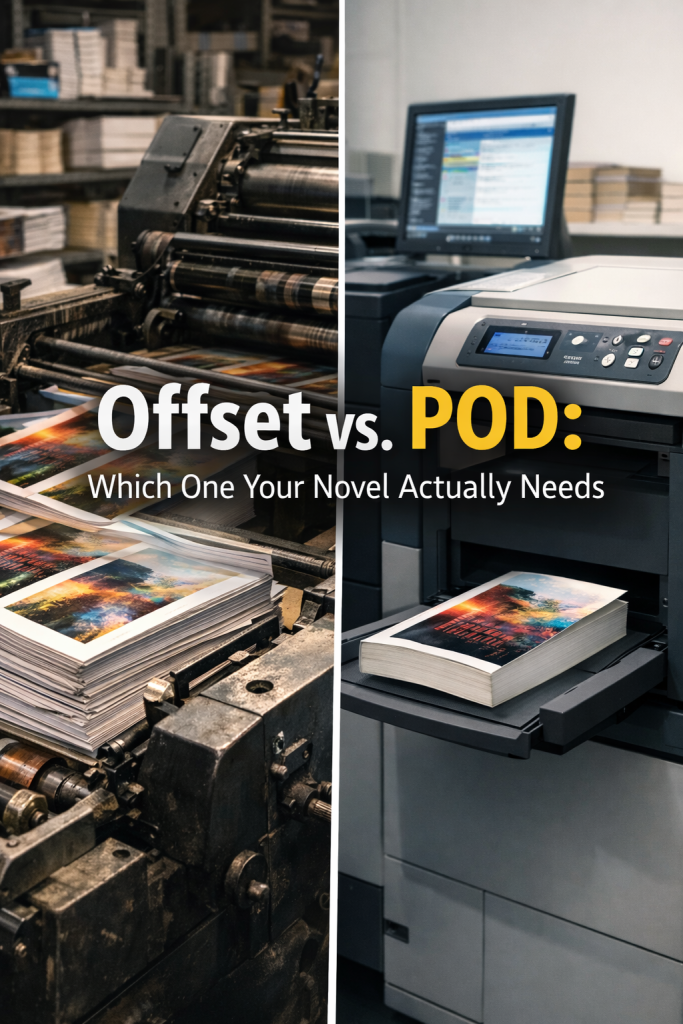
Offset printing is the process trade publishers use. Ink transfers from a plate to a rubber cylinder to paper, in runs of typically 250–5,000+ copies. The setup cost — plates, make-ready, color calibration — is real; the per-unit cost drops steeply as the run gets longer. A rigorous comparison sets offset quotes against three tiers: US-domestic (Thomson-Shore, Sheridan, McNaughton & Gunn), European (PulsioPrint in Bulgaria), and Chinese (QinPrinting, BookPrintingChina, ChinaPrinting4u, and the Ningbo-based group behind printedinchinaonline.com). Each tier buys a different tradeoff on price, timeline, paper selection, and tariff exposure.
Print-on-demand (POD) is digital toner or inkjet printing, one book at a time, on services like KDP Print, IngramSpark, and BookVault. No setup cost, no minimum order. Each unit prints when ordered. A 300-page B&W paperback costs in the low-to-mid single-digit dollar range per unit on KDP and IngramSpark to manufacture; retail you set yourself.
The question the forums love — at what volume does offset beat POD? — is the least interesting part of the comparison. The more useful questions are about what each technology physically produces.
Paper. Offset gives you a real library of choices: 50-lb or 55-lb cream opaque interiors, 60-lb or 70-lb natural for hardcovers, 80gsm–105gsm European offset weights, dozens of opacities and hand-feels. PulsioPrint alone stocks more than 400 paper options including Fedrigoni Palatina, the paper on half the literary hardcovers in a European-indie section. POD gives you two or three. KDP offers 55-lb white, 55-lb cream, and 60-lb white for paperback interiors — and the cream sheet is noticeably thinner than what a trade printer would send.
Binding. Offset paperbacks are perfect-bound with PUR adhesive (stronger than hot-melt), and at higher tiers Smyth-sewn — thread-sewn signatures that let the book lie flat forever. For hardcovers, the gap widens sharply: every Chinese and European offset printer in a typical multi-region quote round does Smyth-sewn as standard at no upcharge. Every POD platform — IngramSpark’s hardcover option, KDP’s case-laminate hardcover, BookVault’s HC — uses glued binding inside a hardcase. KDP adds a cosmetic cloth strip to mimic sewn binding, but the structure is still glued. Readers notice this before they can articulate it: a Smyth-sewn hardcover lays flat on a restaurant table, a glued hardcover creases into a permanent fold at ninety degrees. US digital printers are often explicit in writing about the ceiling: we don’t offer Smyth-sewn binding on this trim size, it would be a perfect-bound book.
Cover. Offset covers run on thicker stock (typically 10-pt C1S or 105-lb cover weight with matte lamination) and support foil stamping, spot UV, and emboss/deboss if the cover calls for them. A typical literary-hardcover spec sheet calls for foil on the spine as standard — and at every overseas offset vendor it is included in the baseline unit price. POD covers are thinner (typically 9-pt for KDP) and limited to matte or gloss lamination. No foil. No emboss. No spot varnish. The same US digital shops that can’t do Smyth-sewn also flag, plainly: we also cannot do foil stamping at this time. Capability floors are what they are — the printer tells you.
Trim accuracy. Offset runs cut to tight tolerance on industrial guillotines — typically ±0.5mm. POD books drift a sixteenth to an eighth of an inch on trim, invisible on one copy, very visible on a stack of ten next to each other on a bookstore table.
Smell, and this isn’t a joke. POD books smell slightly of industrial adhesive for the first thirty days out of the printer. Offset books don’t. Experienced trade reviewers report — off the record — that they can tell a POD book from an offset book before opening the package.
The seven-printer quote comparison — what a real cross-continent run looks like
A rigorous printer-quote process runs no fewer than five vendors across two regions, and in practice tends to land at seven across three. Here is what a typical recent round surfaced — identical specs, identical files, same US delivery address, same split-ship arrangement (150 copies to publisher, 350 to an Amazon FBA warehouse). Every vendor returned a formal PDF quote with line-item pricing. Exact per-unit figures are spec-, quantity-, and timing-specific and tend to mislead when pulled out of context; the relative positions are what generalize across print-vetting rounds:
| Vendor | Region | Binding | Relative position @ 500 copies (landed DDP) | Timeline |
|---|---|---|---|---|
| Union Printing (printedinchinaonline.com) | China (Ningbo) | Smyth-sewn | Within ~6% of the cheapest overseas quote | ~9 weeks |
| Mainland Printing | China (Shenzhen) | Smyth-sewn | Lowest of the seven (baseline for comparison) | 8–9 weeks |
| ChinaPrinting4u | China (Dongguan) | Smyth-sewn | ~15–20% above baseline | 6–7 weeks |
| BookPrintingChina | China (Guangzhou) | Smyth-sewn | ~45% above baseline | 6–7 weeks |
| QinPrinting | China (Shanghai) | Smyth-sewn | ~2× baseline (premium config: full-color interior) | ~8 weeks |
| PulsioPrint | Bulgaria (EU) | Thread-sewn | ~2× baseline (buys timeline: 2–3 weeks total) | ~2–3 weeks |
| PrintNinja | Chicago front / China print | Smyth-sewn | ~3× baseline (US-based project management layer) | ~10 weeks |
All prices include production plus shipping under Delivered Duty Paid (DDP) terms — meaning the printer pays ocean freight, customs brokerage, and any applicable tariffs before the pallet reaches the loading dock. The 7.5% Section 301 tariff on China-origin books still applies at a few cents per book; books are exempt from the 2025 IEEPA tariffs under the First Amendment informational-materials carve-out.
A few things this matrix surfaces that a one-printer quote would not:
- The spread on identical specs is roughly 3× at 500 units. Same book, same binding, same paper weight. That’s the range a working author actually faces if she writes one email to one printer and accepts the first number.
- Smyth-sewn at no upcharge is the Chinese offset tier’s standard. Every Chinese quote in a typical round includes thread-sewn binding in the baseline. The European quote does too. The US domestic digital tier does not offer it at this trim size at any price.
- The “cheapest per unit” is rarely the right answer. In a typical recent round, Mainland Printing came in cheapest. Union Printing came in within ~6% of that — essentially a tie — but with a written price-hold clause (stable unless >5% fluctuation in raw materials), a 25-year reputation, and a 5.0-star TrustPilot rating across 51 reviews. The price delta is real, and so is the reliability delta — the right call depends on whether the book’s cash flow can absorb a 5-week printing delay if the cheaper vendor slips.
- US domestic offset for a Smyth-sewn hardcover at 500 units is not price-competitive. Domestic mid-market shops land in the 2.5–3× China-landed range on comparable specs. That’s the number that makes the China-versus-domestic decision for most literary hardcovers.
- European offset buys timeline, not price. PulsioPrint’s 2–3-week turnaround is extraordinary compared to the 6–9-week Chinese turnaround plus ocean freight. If a launch window is tight and foil-stamped hardcovers are required, Pulsio is the rational call even at the premium. Their paper selection is also the widest available in the European tier.
For the paperback side of the same project — 440-page softcover, 5.5×8.5, 100gsm cream, soft-touch matte cover — the spread narrowed: the three cheapest China paperback vendors were effectively a three-way tie at landed cost, with domestic shops again roughly 2× that. POD paperback on KDP Print lands close to the offset paperback landed cost at 500 units with zero setup cost. At 500 units, the paperback math is genuinely close; below 300, POD wins; above 1,000, offset pulls ahead sharply.
A working printer-vetting methodology
Here is the process. The shape holds from project to project.
Spec lock first. Before emailing a single printer, write the spec sheet. Trim, page count (to the nearest four-page signature), paper weight (100gsm cream is a typical standard for literary fiction), binding (Smyth-sewn for hardcover, sewn-perfect for paperback over 350 pages, PUR on shorter ones), cover stock (300gsm C1S soft-touch matte is a common default), dust-jacket stock (200gsm coated), flap dimension (3.5” is Big Five standard), foil spec, shrink-wrap, FNSKU labeling for FBA, split-ship addresses. Fifteen lines. Every printer gets the same sheet. The same spec sheet is the only reason the quotes are comparable.
Three regions, minimum. Never quote a single country. At least one US-domestic printer, at least one European printer, at least three China-based printers. The domestic quote anchors the top of the range; the European quote buys the timeline-sensitive option; the China quotes compete on price and Smyth-sewn capability. The multi-region comparison is what surfaces the 3× spread and keeps any single vendor from anchoring the conversation.
Named company, written quotes. A serious decision can’t run off a web calculator. Every shortlisted printer has to return a written quote with a valid-through date (30 days standard), a clear payment-terms line (50% deposit / 50% before shipment is modal), and a production-timeline estimate. If a printer will only quote by chat widget and won’t put numbers in email, pass.
Spec-compliance audit before price comparison. Read each quote line by line against the fifteen-line spec sheet and mark conformance. In a typical round, two vendors come back with the cheapest nominal quote but at 80gsm or 90gsm paper instead of the 100gsm specified — a meaningful downgrade on hand-feel that is also a real per-unit price difference when re-quoted at spec. Vendors routinely omit soft-touch matte DJ lamination and assume standard matte. A spec-compliance check catches this before apples-to-oranges distorts the decision.
Physical proof and stock kit. Two samples worth paying for before committing: a paper stock kit (a small fee, often free with shipping charges), and a physical bound proof (a low-three-figure fee, often rolled into the deposit). The stock kit shows what the printer calls “cream 100gsm” actually feels like — which varies enough between mills that the word is not enough. The bound proof reveals what the printer’s Smyth-sewn binding, foil stamping, and lamination quality actually look like in hand. Don’t skip this step. A stock-kit review routinely moves a vendor decision after the price comparison has already pointed one way.
Reputation check. TrustPilot for the rated vendors, direct Google for independent reviews, publishing industry forums (Alliance of Independent Authors forum) for qualitative reports. Years-in-business is a weak signal on its own but a useful gate combined with review volume. A practical floor on the Chinese tier is 50+ reviews with a 4.7+ average.
Split-ship logistics. Not every printer handles split shipping to two US addresses inside a single DDP quote. Some will, some won’t, and the ones who do differ on whether FNSKU labeling is included or billed separately (a small add is typical). Ask explicitly in the initial RFQ and disqualify vendors who can’t handle it — retrofitting the logistics later costs more than the price savings.
The decision matrix. Once the spec-confirmed quotes are in, rank on six axes: landed cost per unit, total landed cost at target quantity, spec compliance, timeline, reputation strength, payment-terms friendliness. The top-two vendors get one additional round of questions. The winner becomes the primary; the runner-up becomes the immediate backup; the remaining quotes get documented with enough specificity to re-engage the field on the next project.
That’s the practice. Two to three weeks to run cleanly. The alternative — emailing the first printer whose marketing page looked professional and paying the first quote returned — is how an author ends up paying a meaningful premium (often 30–100%) over what the same book would have cost with a half-hour of comparison work.
The three-axis decision matrix — the questions that actually decide it
For most literary novels, three questions answer the choice in about ninety seconds.
1. Will physical copies live in independent bookstores on trade terms? Ingram and the major wholesalers stock offset-printed trade paperbacks on standard terms (55% discount, returnable, or 40% non-returnable via IngramSpark’s expanded catalog). Most indie bookstore buyers order through Ingram’s trade catalog and will routinely pass on a POD-only title. The American Booksellers Association is straightforward about this in its IndieCommerce resources: face-out-quality trade paperbacks is shorthand for offset-printed, trade-distributed stock. If physical copies need to be carried by independent bookstores — even twenty-five of them, on consignment — the answer is offset.
2. Is there a demand signal past 500 units inside the first 18 months? Pre-orders. A newsletter list that converts reliably. Events on the calendar that will move stock. A bookstore letter of intent. An author platform that makes a 500-unit launch realistic rather than aspirational. If yes, offset wins on unit economics alone. Break-even against POD on a 380-page hardcover — POD unit cost is roughly 2× an overseas offset landed unit cost at 500 copies — is reached well before the 500-unit mark. Past that break-even, every offset hardcover captures meaningful additional margin vs. the same copy on POD. At a 500-unit run, that margin recapture can cover the cost of a mid-tier editorial pass or a physical book tour. If no — if demand is genuinely uncertain, the book is a debut with no platform — starting POD is not a consolation prize. It’s an honest read on the risk.
3. Does the cover design require finishes POD can’t produce? Foil stamping. French flaps. Deckle edge. Headbands. Specialty papers. Smyth-sewn anything. If the designer’s concept requires any of these, the question is already answered — POD simply cannot produce them.
If the answers are yes, yes, yes — offset, and the question becomes which offset printer. That’s the seven-quote process above.
If the answers are yes, no, no — bookstores are the plan, but demand is uncertain and the cover is unfussy — a hybrid is often the right call.
If the answers are no, no, no — POD is the right call. It isn’t a compromise. It’s the right tool for the job.
The hybrid model — what sophisticated indie imprints actually do
Trade publishers don’t really pick one or the other. They offset-print the first and second printings for launch and bookstore distribution, then switch to POD (typically via Ingram Lightning Source) for long-tail availability once the initial run winds down. A careful indie imprint does the same at smaller scale.
A typical structure for a debut hardcover launch:
- Months 0–3. 500-unit offset hardcover run, Smyth-sewn with dust jacket, shipped DDP from China at mid-single-digit dollars per unit landed. Split-ship: 350 copies to an Amazon FBA warehouse, 150 copies to the publisher for events, direct sales, ARCs, and bookstore consignment. Capital outlay for the print run itself sits in the low four figures on this spec, plus a modest ISBN/setup/proof budget. FBA handles Amazon fulfillment at Prime speed; home inventory covers everything else.
- Months 3–12. Sell through the initial run via FBA, direct channels, and bookstore consignment. If demand holds through month 9, order a second 500–1,000-unit offset printing on the same specs (slightly cheaper per unit because the setup cost amortizes across two runs). If demand cools, don’t — let FBA inventory ride down and shift to POD for stockout coverage.
- Month 12+. IngramSpark POD carries the long tail for libraries, non-Amazon retail, and stockout coverage while offset inventory rebuilds. Paperback runs on KDP Print for Amazon paperback demand. Hardcover POD (IngramSpark) provides library orderability even when physical offset inventory is briefly out.
That structure gives the book a Smyth-sewn hardcover on bookstore shelves and on Amazon with Prime shipping, a paperback cheaper to produce than offset would be at low volume, and no warehouse lease past year one. The capital at risk for the core offset run is modest in absolute terms; the payoff structure holds even at fairly conservative year-one sell-through.
The number worth internalizing: a 500-copy Smyth-sewn offset hardcover run from a competent Chinese printer, shipped DDP to a US warehouse, lands in the low four-figure range all-in. That is not a pie-in-the-sky trade-press number. It is the real 2026 floor price for a properly produced hardcover novel, and it is within reach of most debut authors willing to run the vetting process.
Sources worth knowing — the landscape, named
The printer landscape is wider than the forums suggest. The set worth short-listing.
Chinese offset — the competitive tier. QinPrinting runs a 5-star TrustPilot across hundreds of reviews with US/Canada/Australia offices. Union Printing / printedinchinaonline.com has emerged as a recent front-runner — 25+ years in business, written price-hold language. Mainland Printing has come in cheapest in recent comparisons. BookPrintingChina has the highest review volume (28+ years, 4.9 TrustPilot across 200+ reviews, FSC-certified). ChinaPrinting4u sits mid-range.
European offset — the timeline alternative. PulsioPrint (Bulgaria) offers 400+ paper options, thread-sewn available, 2–3-week total turnaround, no China-tariff exposure.
US offset and premium-managed Chinese. Thomson-Shore, Sheridan, McNaughton & Gunn anchor the US domestic offset tier; PrintNinja runs premium-tier Chinese offset with US-based project management at a meaningful premium.
POD. KDP Print — lowest friction, Amazon-only, best royalty on Amazon sales. IngramSpark — expanded distribution to bookstores and libraries, returnable/non-returnable options, slightly higher unit cost; the right POD choice if any bookstore availability matters. Ingram Lightning Source — IngramSpark’s enterprise sibling, the standing POD infrastructure most trade publishers use for long-tail fulfillment. BookVault — better build quality than KDP, strong for international, smaller reach than Ingram.
Industry references. Publishers Weekly’s manufacturing coverage is good macro context on printing-industry tides. IngramSpark’s own comparison of IS vs. KDP is honest about the tradeoffs. The Alliance of Independent Authors printer directory has qualitative vendor reports from working authors.
One thing worth naming: enrolling the same title in both KDP Print and IngramSpark’s expanded distribution simultaneously creates a direct channel conflict on Amazon. The two services can compete against each other on your own listing, which is never what you want. The clean answer is KDP for Amazon sales, IngramSpark for everything else.
Tools — for the desk drawer
The templates that earn their keep on every print-vetting round:
- The 15-line spec sheet. Trim, pages, paper weight, cover stock, lamination, DJ stock, flap width, binding, endpaper stock/color, foil, board weight, color interior (1C/1C vs 4C/4C), quantity tiers to quote (250, 500, 1,000), split-ship addresses, FNSKU + shrink-wrap. One sheet, identical for every printer.
- The seven-vendor RFQ list. A standing list of printers to quote across three regions. Five minimum, seven standard.
- The spec-compliance tracker. Fifteen spec lines on the rows, vendors on the columns, cells marked ✓ / ⚠ / ✗ / not stated. The first cut before any price comparison.
- The landed-cost calculator. EXW unit price + shipping + duty + last-mile delivery + labeling + shrink-wrap, per quantity tier. The number that matters for decision-making is landed, not EXW.
- The break-even worksheet. Offset landed cost vs. POD unit cost at every 100-unit tier from 100 to 2,000. The crossover is the one number the spreadsheet is for.
- The three-axis decision matrix. Bookstore distribution (y/n), 500-unit demand signal (y/n), specialty-finish requirement (y/n). Printed on the first page of every project brief.
Industry-side tools: the KDP printing cost calculator and the IngramSpark print-and-ship calculator are the two POD estimators to bookmark. For independent ocean-freight quotes outside a DDP package, Freightos and Flexport’s sea-freight rate tool are the working-author benchmarks.
The offset-vs-POD decision doesn’t have to feel like a gamble. Run the spec sheet, quote three regions, read the compliance column before you read the price column, and the right answer usually tells you which one it is. You’ll know the book you’re making, and you’ll know what it cost to make it properly — which is most of the confidence the decision needs.
e.
Cross-links
- For the full vendor tour across mainland China, Europe, and the US: Seven Overseas Hardcover Printers Worth Knowing (publishes June 1).
- For the distribution choice between Ingram, KDP, and hybrid — the other half of the print-plus-distribution decision: Ingram vs. KDP vs. Hybrid (publishes May 25).
- For whether a hardcover edition makes sense for a debut at all: The Hardcover Question (publishes June 11).
- For why the interior specs drive printer choice as much as the cover: Why Typesetting Is Not DIY (publishes May 21).