The most common mistake authors make about proofreading is treating it as the last opportunity to keep editing. They send the manuscript through revision, line editing, and copyediting, and somewhere in the back of their minds they file the proofread as a final safety net, a chance to rethink that paragraph in chapter eleven that never quite sat right. Then the proofs arrive, and they start rewriting. It is one of the more expensive instincts in publishing, and it comes from a misunderstanding of what a proofreader is actually looking at.
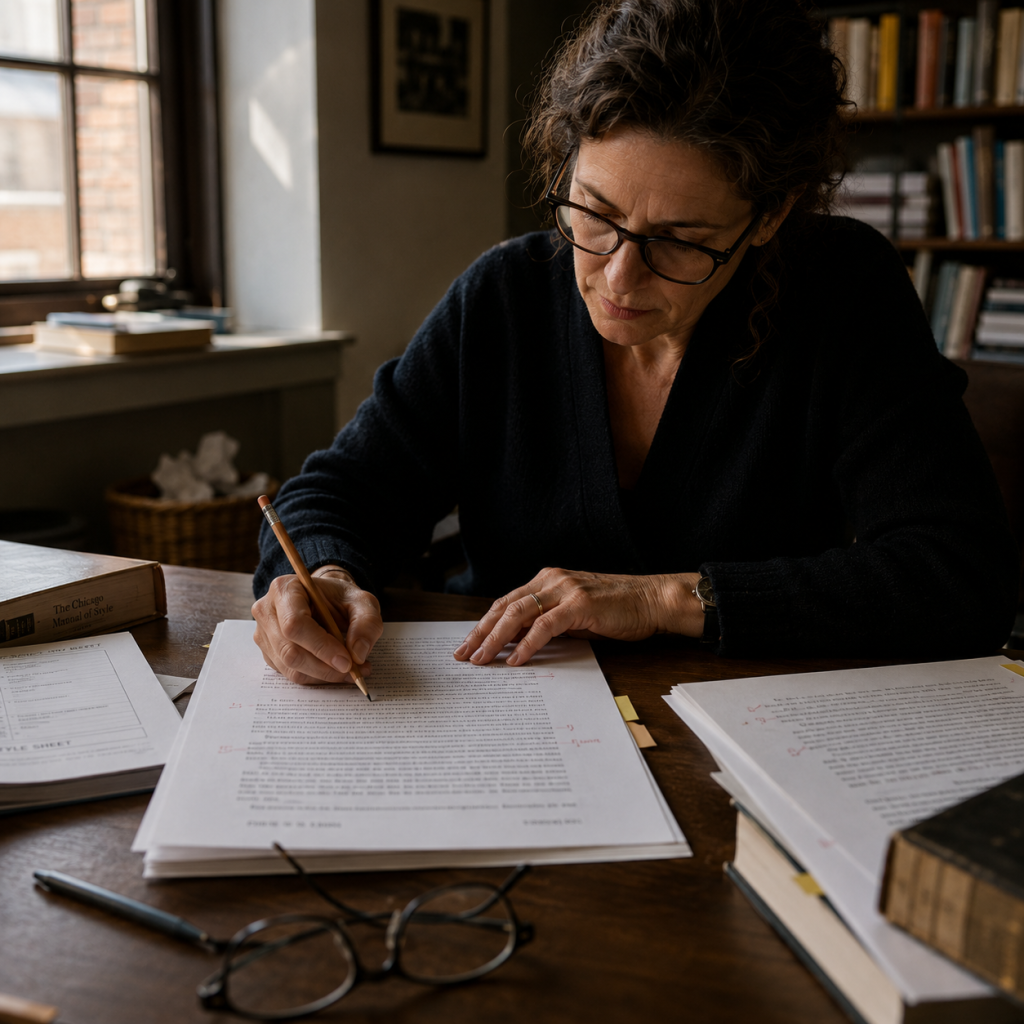
A proofreader is not reading your manuscript. They are reading your book, the designed object, with its real pages, its chosen typeface, its margins and running heads and chapter openings laid out exactly as they will print. That distinction is the whole reason proofreading comes where it does. By this stage the text should be stable, the style sheet should exist, and the editorial decisions should be settled, because the proofreader’s job is not to reconsider the writing. It is to make sure the book that was made matches the book that was approved, and to catch the new problems that only appear once words become pages.
The Errors That Only Live in Pages
Layout introduces an entire category of errors that simply do not exist in a manuscript file, and these are the proofreader’s real quarry. A widow, a single word stranded on its own line at the top of a page. An orphan, a lone opening line marooned at the bottom. A bad word break that hyphenates “therapist” across a line in a way that produces an unfortunate first syllable. A scene break that vanished because the blank line carrying it fell at a page turn and no longer reads as a deliberate gap. An italicized title that came through in roman because something went wrong in the conversion. A running head that still says the wrong chapter title because it didn’t update. A first paragraph that indented when the design says opening paragraphs should sit flush left.
None of these were visible in the Word file, because none of them existed yet. They are artifacts of typesetting, and a reader notices every one of them, if only as a flicker of wrongness they can’t quite place. The proofreader is the first person to read the book as a reader will encounter it, and that fresh, page-level pass is something no earlier stage can provide.
A proofread also checks the proof back against the style sheet. If the book decided on “toward” rather than “towards,” on spelling out numbers under one hundred, on a particular hyphenation of a recurring compound, the proofreader confirms the typeset pages honor those decisions, because conversion and last-minute fixes have a way of quietly undoing them.
Why a Late Change Is Not a Free Change
Here is the part that surprises authors. Before layout, changing a sentence is contained. You alter the words, the file adjusts, and nothing else moves. After layout, changing a sentence can be a small act of demolition. Add three words to a paragraph and the last line may push to a new page; now the page break has moved, a subhead that used to sit comfortably is stranded at the bottom of a page, and the running heads two pages later need rechecking. A change you thought was local has rippled outward, and every page it touched has to be read again for new problems the edit itself created.
This does not mean proof changes are forbidden. It means they need a reason, and the useful test at this stage is to sort every impulse into one of three buckets: is this an error, a genuine clarity problem, or a preference? Errors get fixed, always. Real clarity problems, the kind where a reader would actually be confused, usually get fixed. Preferences are where discipline has to hold, because the proof stage arrives exactly when the writer’s nerves do. The book is almost gone, almost permanent, and there is a powerful temptation to keep touching it, to swap a good word for a slightly different good word, to smooth a sentence that was already fine. That is not correction. That is anxiety with a pencil, and it introduces far more risk than it removes.
A clean copyedit is what makes this restraint possible. The more thoroughly the earlier stages did their work, the fewer real problems remain at proof, and the easier it is to keep the pass focused on what it is for.
Why It Should Not Be You, and Not the Same Eyes
There is a practical reason proofreading is usually given to someone who has not lived inside the manuscript, and it is worth understanding rather than resenting. By the time a book reaches proofs, the author has read it so many times that they no longer see the words; they see their memory of the words. The eye slides over the sentence it expects and supplies the period that isn’t there, the “the” that’s missing, the “form” that should have been “from.” This is not carelessness. It is how reading works once a text is familiar, and it is exactly why authors are the worst proofreaders of their own books. A fresh reader, encountering the pages cold, sees what is actually printed rather than what was intended.
It is also why the proofread is ideally not done by the same person who copyedited. A copyeditor who has already passed through the manuscript carries the same blindness, having taught their eye what to expect. Different eyes catch different things, and the small additional cost of a genuinely fresh read at proof stage is among the best money a careful publisher spends, because the errors it catches are the ones that would otherwise survive into print, where they become permanent and, often, faintly embarrassing.
If you must proofread your own work, the standard tricks exist because they force the familiar to look unfamiliar again. Read the book in a different format than you drafted it, on paper if you wrote on screen, in a different font, at a different size. Read it backward, paragraph by paragraph, so the meaning stops carrying you forward and you’re left looking at the mechanics. Read it aloud, which catches dropped words and clumsy rhythms the silent eye forgives. None of these match a skilled stranger’s first read, but all of them are better than reading the proofs the same way you read the draft.
The Dignity of the Final Pass
It would be a mistake to read all this as a demotion of proofreading. The opposite is true. The proofread is the last form of care a book receives before it becomes permanent, and it is care of a specific, generous kind. It respects the reader by removing the small distractions that would pull them out of the story. It respects the writer by protecting the choices that were already made well, rather than reopening them. And it respects everyone who worked on the production by keeping the final round of changes controlled, deliberate, and necessary.
Proofreading comes last because it belongs to the finished thing. It is not the stage where a book becomes a different book, or a better-written one, or a more daring one. Those stages have already happened. Proofreading is where the book that has already been made is looked over, one last time, with clear eyes, before it goes out to meet the people it was written for. There is something quietly satisfying in that, the sense of a long process finally narrowing to a single, careful question: is it ready? When the proofread is done well, the answer can be yes without an asterisk.
At the proof stage, fix what must be fixed and let the settled work stay settled. The bravest thing you can do with a finished book is leave it alone.
e.
Cross-links
- Copyedits Are Not Cleanup – on the standards pass that should happen before layout
- What a Line Edit Fixes – on why sentence work comes earlier
- The Revision Triage Pass – on separating necessary change from nervous change